
Dedari Worship and Heavenly Nymph Tales in Bali
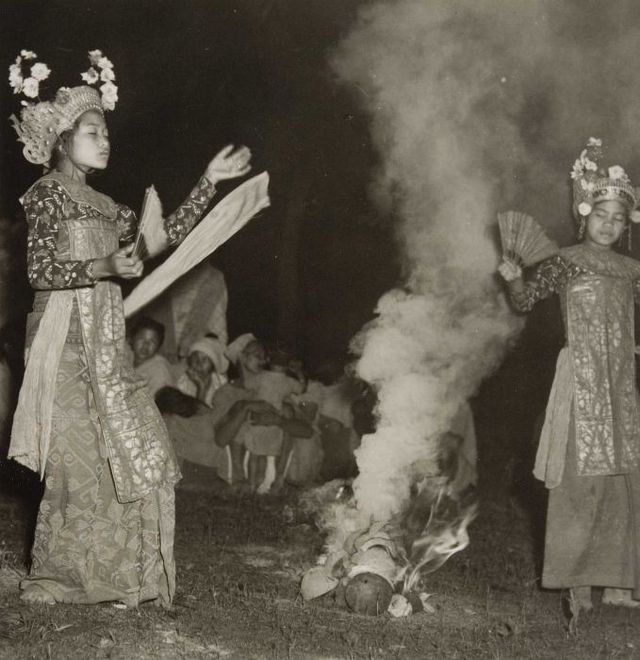
4.1. Various Representations of the Supernatural
In the islands of Bali, one can discern numerous beliefs and cultures related to the heavenly nymph, called dedari, that have developed since ancient times. The most typical example is the exorcism ritual of “Sanghyang Dedari” in which a female dancer acts as a medium for the possession of sacred dedari, with this ritual usually being performed as part of rice farming ceremonies in rural villages in Bali. Though the tradition has fallen into decline in accordance with modernization, it seems to be undergoing a revival today due to UNESCO’s 2015 announcement that includes the Sanghyang Dedari among the nine traditional Balinese dances on its World Heritage List. (link: 9 Balinese dances make UNESCO heritage list - National - The Jakarta Post).
A small fan-headed goddess “Cili,” who frequently appears in Balinese rituals, is also an important symbol related to local nymph worship. One can see various ritual objects depicting Cili displayed at the Bali Museum in Denpasar. The most common offering of Cili is made from palm leaves, but earthenware or bronze figures are also included. As Cili’s image is often used in the context of praying for a good harvest, Paeo, an education and conservation officer at the Bali Museum, says, “Cili is an incarnation of the goddess Dewi Sri, who was known throughout Indonesia before the arrival of Hindu culture. Dewi Sri is also called Pertiwi, the Great Mother, and is considered a symbol of fertility who give birth to life.” (link: NUSABALI.com - Patung Cili Simbol Kesuburan Bali).
Given these features, it could be suggested that Balinese Dedari worship has developed into multiple representations within a gradation between animistic culture based on agricultural society and imported cultures from India, China, and Java. For example, the heavenly nymph “Supraba,” who appears in Balinese traditional songs and performing arts, has its origin in ancient Javanese poetry (kakawin) and shadow puppetry (wayang kulit). However, Balinese people include this character in a variety of contexts: while it appears in the lyrics of gending sanghyang (a divine summoning song) in the Sanghyang Dedari ritual, it is also incorporated into a shadow play based on the Indian epic Mahabharata. In this way, the image of the heavenly nymph in Bali, whose name varies depending on context, lives freely in the creative imagination of Balinese people, as if flying with the magical feather robes, beyond temporal and spatial boundaries.
4.2. The Rajapala Story
In Bali, the Rajapala story is the most famous among the folktales concerning human-nymph marriage. These are also composed of Yuko Momose’s classification of storylines from A to E (see 3), among which ‘E’ has an outstanding variation. Traditionally, Balinese people have transmitted folktales orally depending on the imagination and creativity of each storyteller. In addition, folktales have been transmitted in the form of ritual poetry called Geguritan.
In Indonesia, “transmitting folktales through picture books” is a relatively new culture that emerged in the modern era, which is why there are few picture books telling of the Rajapala story in Bali even today. One of the few examples is a picture book published in 1978 by Javanese author Siswanto Partodimulyo and Javanese illustrator Julie Sutono (Pic 4-1, 4-2, 4-3, 4-4). However, due to the unpopularity of picture book layout techniques in Indonesia at that time, Partodimulyo and Sutono’s work comes across as a book for reading rather than a picture book. In the background, the Suharto administration in the 1970s and 1980s actively collected and published folktales from all over Indonesia to promote their “national culture.” Since Javanese intellectuals in particular were at the center of this movement, the 1978 Rajapala picture book was published as one of the “World Stories Series (Kisah Seputar Buana)” (see the storyline in 4-3).
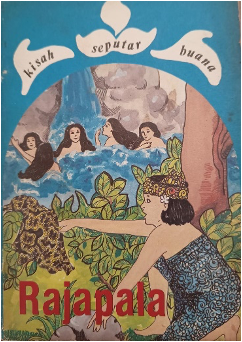
4-1 The cover of the picture book Rajapala (1978)
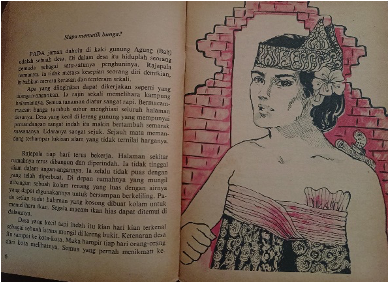
4-2 Rajapala: The main character
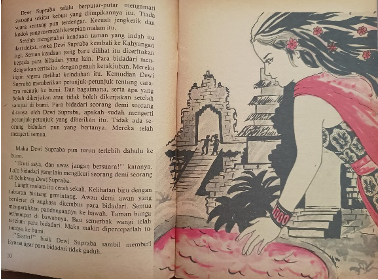
4-3 The Descent of Supraba, a Heavenly Nymph
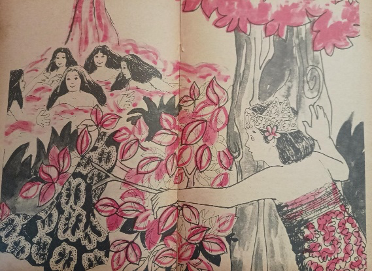
4-4 Rajapala Stealing Supraba`s Magic Robe
Nevertheless, this picture book is only one version of the story. It partly overlaps with the “Joko Tarub Story” in Java, particularly in the episode in which “a single grain of rice makes a pot full of cooked rice” and “the wife’s feather robe was finally found in a granary.” Therefore, it is possible that this picture book of the Rajapala reflects the Javanese author’s thoughts due to the nature of folk tales that change freely according to storytellers’ preferences.
What, then, is the “true” Rajapala story according to the Balinese people? Of course, there is no correct answer. However, one common pattern is that: 1) A man (Rajapala) steals a nymph’s feather robe so they can marry (as seen in S. Partodimulyo’s picture book), 2) After the wife (nymph) gives birth to a boy, the feather robe is found and the nymph returns to heaven, 3) Rajapala retreats to the forest to dedicate the rest of his life to meditation, and 4) Their son left behind grows up to be an important minister to the kingdom. This pattern is introduced via two websites; however, the Indonesian Wikipedia page for the Joko Tarub story describes the name of the heavenly nymph in the Rajapala story as Ken Sulasih and her son as Durma.
The Rajapala Story: The Legend of the Feather Robe of Bali (balitaksu.com)
Legenda Jaka Tarub - Wikipedia bahasa Indonesia, ensiklopedia bebas
In addition, one can observe an interesting recent trend whereby YouTube has become a medium for transmitting Balinese folktales, which did not have a tradition of printed picture books. In this example from YouTube (narrated by Wayan Suleman), Rajapala is a hunter who marries a heavenly nymph named Ken Sulasih and eventually lives alone in a forest (this storyline is common in Bali).
4.3. Storyline of the Picture Book The Rajapala Story (S. Partodimulyo, 1978)
Source: Rajapara: Kisah Seputar Buana 3 Cerita dari Bali, written by Siswanto Partodimulyo and illustrated by Julie Sutono, Jakarta: PT Gaya Favorit Press, 1978
I Who Stole the Flowers?
Once upon a time, there lived a young farmer named Rajapala in a small village at the foot of Mount Agung. Thanks to Rajapala’s hard work, the village was known across the country for its beauty, constantly overflowing with flowers. Rajapala was proud of it, but he felt that there was one thing still wanting: he did not have a wife. Then, one morning, he noticed something strange in one of his prized flower gardens: many of buds that were about to bloom had been picked. I saw them yesterday, but they’re gone this morning, so someone must have picked them at night, he thought.
II Midnight Visit
The reputation of this beautiful village was brought not only to the people in the capital but also to the gods in heaven. The fragrance rising from the colorful flowers always reached the heavens, prompting the heavenly nymphs to discuss how they could bring those wonderfully fragrant flowers to their realm. Eventually, the most beautiful nymph, named Supraba, was sent to earth. One night, when the earth was lit by a full moon, Supraba descended from heaven to see what was happening on earth, and she was captivated by the beautiful sight of villages and nature at the foot of Mount Agung.
After returning to heaven, Supraba enthusiastically told her friends about the beautiful scenery she had witnessed from the sky. Intrigued by her story, the other nymphs decided to follow Supraba down to earth. When they landed in Rajapala’s village, they were fascinated by the magnificent scenery, which was just as Supraba had described. They immediately picked fragrant flowers, bathed in a pond filled with pure water, and then returned to heaven.
In heaven, they enjoyed the flowers in their own way, using them as hair ornaments or decorating the palace. In this way, visiting the earth with friends to pick flowers and swim in the pond became their greatest form of entertainment, which they carried out every night when there was a full moon.
III Woman of Unsurpassed Beauty
Meanwhile, Rajapala’s heart was aching due to the frequent theft of the flowers. Though he investigated the area, he found no sign of damage—he only noticed that the area around the pond was wet, as if someone had bathed there. Rajapala was convinced that the thief would come at night, so he decided to keep watch every night. However, as nothing happened for a while, he felt his efforts were for futile.
A change occurred one night when there was full moon. Rajapala, who was keeping watch by hiding in the shadows of a flower garden, saw several shadows swaying on the other side. As he held his breath and stared at the shadows, he heard small noises and whispers. Then, a pleasant fragrance came to him. After rubbing his eyes many times, the figures gradually came into view. They were unbelievably beautiful young women.
Rajapala was confused, unsure whether they were ghosts or nymphs. Meanwhile, the women took off their clothes and started swimming in the pond. Rajapala watched them and decided to let them enjoy the experience. He then picked up six feather robes, which the nymphs had cast off close to him, and placed them near the pond before leaving the place.
As dawn approached, the nymphs prepared to leave the pond, putting on their feather robes. However, one nymph was at a loss, as she could not find her robe and would not be able to return to heaven without it. Her friends looked for the robe together but were unable to find it. Finally, when the sun rose, the six nymphs had to fly away, weeping and leaving the other nymph behind. Thus, Supraba was left alone on earth.
By the pond, Supraba kept on singing in a beautiful voice while crying, “Someone please find my feather robe.” Hearing her voice, Rajapala approached her and asked, “My lady, what is wrong?” While still crying, Supraba explained that she was a nymph who had descended from heaven and could not go home without her feather robe. Entranced by Supraba’s beauty, Rajapala pretended not to know anything, saying, “If you trust me, I will protect you.” At a loss, Supraba decided to borrow a cloth from Rajapala and follow him to stay at his house while she was bound to remain on earth.
Supraba settled down in Rajapala’s house, which was simple but neat. However, she could not stop thinking about heaven. She asked Rajapala, “How and when can I return to heaven?” to which Rajapala replied, “It is all God’s (Sang Hyang Widi) will that you and I met.” In this way, Supraba became Rajapala’s wife.
IV Big Happening
Supraba subsequently gave birth to three daughters with Rajapala. They were named Kusuma, Puspita, and Ratna. Thanks to Rajapala’s hard work, the crops were always bountiful, and the family had no shortage of food.
However, Rajapala gradually became curious. His wife cooked a lot of rice every morning, but the amount of rice in the granary remained the same. It transpired that, due to the power of a spell that Supraba had learned in heaven, she was able to turn a single grain of rice into a full pot. That is why the amount of rice in the granary never decreased.
One morning, Supraba overslept, which was unusual for her. Rajapala had gone out to work on the farm, and Supraba immediately started to cook rice for her children, who were waiting for supper. Just then, Rajapala returned, whereupon Supraba departed to carry out other household chores. As she did so, she told her husband, “Please do not open the lid of the pot on the fire until I return.”
After a while, Rajapala noticed that the boiling water in the pot was about to overflow. He remembered his wife’s words but could not just leave the pot there, so he opened the lid to let out the steam. To his surprise, a single grain of rice was waving in the pot. He closed the lid, wondering, “Did my wife forget to put in the rice?” However, the water in the pot remained quiet after that.
Supraba came back home, and Rajapala left the kitchen to return to work on the farm. As usual, Supraba waited until the rice was done and opened the lid. However, all she saw in the pot was a single grain of rice. Supraba rushed to Rajapala and asked him with anger, “You opened the lid, didn’t you?” Rajapala was at a loss for an answer, and Supraba continued, “You have done a terrible thing. Not only do I have to do the hard work of threshing the rice every morning, but the rice in our granary will rapidly decrease from now [on] because of you.” Just as Supraba predicted, the family’s life became harder and harder, consuming more rice than gaining.
V Secret Revealed
One morning, when Supraba went into the granary to cook rice from the little that was left, she felt like touching something when she put her hand into the small pile of rice. As she pushed the rice aside, she found the feather robe that she had lost before.
Supraba immediately called Rajapala and said sternly, “You lied! You know who hid my robe at that time!” Rajapala was embarrassed and stayed silent while Supraba continued: “I must return to heaven. Please love our daughters[;] I am watching over them from heaven.” Rajapala panicked and tried to stop her, saying, “How can my daughters survive without their mother?” But Supraba did not change her mind, stating, “If it was God’s will that you and I met, then it is also our fate by God that we part ways now.” She then put on the feather robe and flew off to heaven. Rajapala regretted his foolishness in hiding the robe in the storehouse instead of throwing it away, and he was at a loss as to what to do.
VI Where’s Mom?
After Supraba disappeared, Rajapala worked hard every day in the farm and looked after the children alone. The once tidy house became messy, and Rajapala’s tired body became thinner and thinner. Even while enduring such a hard life, Rajapala followed Supraba’s wish and continued to love their three daughters. However, they often made Rajapala feel awkward by asking, “Where is mom?” Furthermore, due to poor food, the daughters gradually became sickly. Finally, after all three suffered from high fever, the eldest daughter Kusuma became lame, the second daughter Puspita became mute, and the third daughter Ratna became blind. Rajapala was in deep despair and repeatedly said to himself, “Supraba, has your heart also turned away from us...?”
VII White Crow’s Help
Although Supraba spent her days in heaven thinking of her daughters, she was no longer allowed to come down to earth. One day, she saw the daughters’ figures in her eyes and her heart began to throb. However, a white crow appeared in the vision, and an idea came to Supraba’s mind. She said to the crow, “Please see how my girls are living and tell it to me.” The crow immediately flew down to Rajapala’s house and saw the three disabled daughters before returning to heaven and informing Supraba by gesture. Shocked by their misfortune, Supraba immediately brought out a palm leaf and ordered the white crow to carry it and cure the girls’ illness. The crow put it in his mouth and went back down to Rajapala’s house, where he rubbed Kusuma’s feet, Puspita’s mouth, and Ratna’s eyes with the palm-leaf. Miraculously, the three daughters retrieved their health, while Rajapala was extremely surprised and could only offer deep gratitude to God for His mercy. The three girls grew up healthy and supported their father. Thereafter, their beauty and good nature caught the eye of princes, and all three subsequently married into royal families and lived happily.
4.4. Sacred Places Related to Dedari/Bidadari
From 2023 to 2024, the author conducted a survey of specific sites related to heavenly nymphs in Bali. The sites include the word Dedari (Balinese) or Bidadari (Indonesian), which mean “heavenly nymph.” The research results are compiled in the original Google My Map, with explanations, photographs, and videos. To visualize the broader connections of heavenly nymph legends, the map encompasses other areas such as Java and Japan, which also have similar sacred sites. The research in Bali was carried out by the author and that in East Java was done by the team of Universitas Negeri Surabaya (Mr. Nasution, Ms. Septina Alrianingrum, and Mr. Aditya Indrawan). More information will be added in the future.
The 27 sites on the map have been identified in Bali by the author’s fieldwork. These include new tourist spots such as Taman Bidadari in Ubud. However, whether old or new, most are related to the worship of water. Below are five features seen in these sacred sites in Bali.
① The places are largely used to draw holy water for rituals.
② The water at the sites is believed to have medicinal uses.
③ Many are in hilly areas such as mountain slopes and valleys.
④ They are located in rice-farming areas near rice paddies or rice terraces.
⑤ The sites, which include temples or shrines, are mostly by owned by individuals or farmers’ communities (subak), not by villages.
Further to the above, one can also see a regional tendency in distribution. Categorized by prefecture, there are 10 sites in Tabanan, 5 in Karangasem, 3 in Bangli and Badung, 2 in Gianyar, and one in Klungkung.
In addition to the concentrated distribution in rice-farming areas such as Tabanan and Karangasem, most sites are related to a network of rivers from mountains. On the other hand, the existence of this feature has not been confirmed in dry areas such as Negara and the northeastern region of Karangasem. These facts suggest that Balinese worship of heavenly nymphs (dedari) is largely embedded in local rice farming culture. Considering other examples, such as the content of the Rajapala story and various representations of goddesses in ritual practices (Cili or Dewi Sri: see section 4-1), it can be said that an image of “supernatural power for fertility” overlaps Balinese dedari in local recognition of nature.