
Sri Tanjung as a Book: Sri Tañjung: Een Oud Javaansch Verhaal (written by Prijono)
6.1. Author’s Biography
This section introduces a book version of the Sri Tanjung story published in the colonial period. According to Sumardi (1984), the author, Prijono, was born in 1907 in Yogyakarta, Central Java. As his father was a courtier (abdi dalem), Prijono’s family belonged to priyayi, the local elite class, and Prijono was privileged to receive a Dutch-style education, studying at the Hollandsch-Inlandsche School in Yogyakarta and graduating from the Algemeene Middelbare School (Modern High School) in Surakarta in 1929. He also learned Javanese dance at a local dance school (Krido Bekso Wiromo), absorbing both Western literacy and traditional Javanese culture.
After graduation, Prijono moved to Paris and completed the French language course (Cours Mayon) in 1932. Then, due to his strong interest in literature, he moved to the Netherlands and enrolled in the Department of Oriental Literature at Leiden University. He eventually obtained a Ph.D. in 1938, with his doctoral thesis Sri Tañjung: Een Oud Javaansch Verhaal being published in the same year (Photo 6-1). Prijono spent his student life in Leiden amid the nationalist movement, participating in organizations such as the Indonesian Association (Perhimpoenan Indonesia), the Student Association for Promoting Indonesian Arts (SVIK), and the Indonesian Student Association (Roekoen Peladjar Indonesia), which were influenced by Budi Utomo in Java (Stutje 2016: 227). In this milieu, Prijono contributed to developing Javanese studies through his research on medieval Javanese literature while promoting Javanese performing arts in the Netherlands with his fellow members of SVIK. In recognition of his active involvement in SVIK, he was made an honorary member in 1938.
Returning to Indonesia in 1938, Prijono resumed his life as a teacher in Batavia (now Jakarta) amidst the international political turmoil that led to World War II in 1939 and the German occupation of the Netherlands in 1940. He was appointed by the Directorate for Education and Religion (Directeur Onderwijs en Eredient) to work at a private school run by the colonial government in 1938 and taught at the Recht Hooge School (RHS) the following year. In 1942, when the Japanese military occupation began, he became the principal of the RHS (Sumardi 1984: 12). With the formation of the new Republic Cabinet in 1945, Prijono was employed as a national civil servant. He then advanced from being a founding member and a professor at the Faculty of Literature of Gadjah Mada University to being a professor within the Faculty of Literature at the University of Indonesia. In recognition of these career milestones, he was appointed Minister of Education and Culture in the Sukarno Cabinet in 1957, where he achieved many accomplishments prior to his retirement in 1966.
Prijono’s first ministerial act in 1957 was the establishment of Indonesian orthography based on the International Orthographic Algorithm (IPA), termed Ejaan Prijono-Katoppo based on the names of Prijono and his collaborator. As a writer, he also published many works such as Modern Animal Stories including the Profit-Seeking Mission (M. M. M dan Lain2 Tjeritera Binatang Moderan) in 1954, a collection of lectures titled Reflections on Indonesian Education and Culture (Glimpses of Indonesian Education and Culture) in 1964, a collection of Romanian folktales (Kisah-kisah dari Rumania) in 1964, and a book of Javanese literature (Serat Djaksura-Tresnawati Mawi Sekar) in 1966 (all published by Balai Pustaka). During his time as minister, he promoted many overseas performances of Indonesian performing arts and also published a book on traditional performing arts entitled Indonesia Menari (Indonesia Menari/Indonesian Dances) in 1988. However, Prijono was dismissed as minister following the fall of President Sukarno in 1966 and passed away three years later in 1969, which is why the last book was published posthumously. As a priyayi with Western learning and a local mind, or a “pudjangga menari (dancing literary man),” he dedicated his life to developing the new republic by promoting both literacy and the aesthetic of traditional culture.
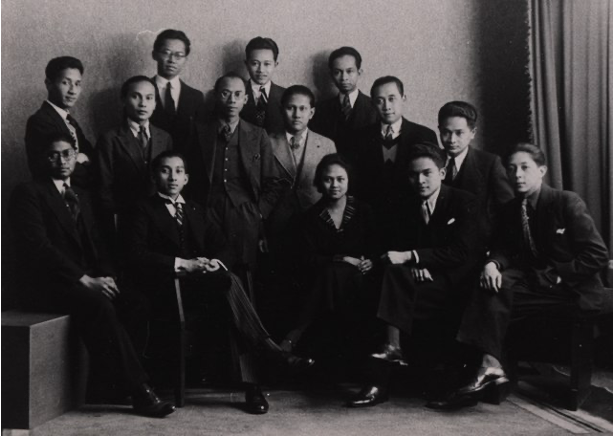
6-1 Prijono in Leiden (Shelfmark: KITLV403229, Title: “Indonesische studenten te Leiden,” published in 1933)
6.2. Overview of the Book
Prijono’s book, Sri Tañjung: Een Oud Javaansch Verhaal, deals with the palm leaf manuscripts (lontar) discovered in Bali (Photo 6-2). This work was published in 1938 by two publishers, Nederlandsche Boek-en Steendrukkerij (1897–1998) in The Hague and Burgersdijk & Niermans-Templum Salomonis (1894–) in Leiden (Photos 6-3, 6-4). From the description on the first page, it can be determined that the former was published as a printed book for the university library’s collection, while the latter was published as an academic book for general sale. As shown below, both books have the same structure after the table of contents.
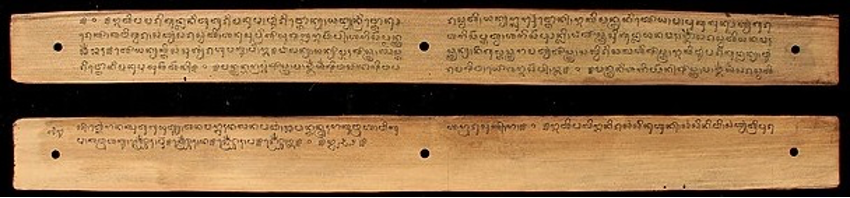
6-2 An Example of Lontar (Creative Commons Attribution-Share Alike 4.0)
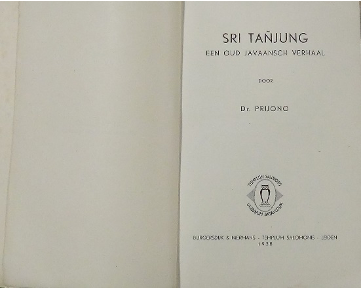
6-3 Prijono's Book 1
(Published by Nederlandsche Boek-en Steendrukkerij)
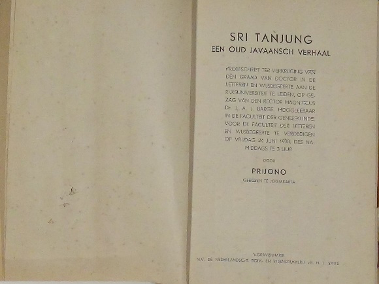
6-4 Prijono's book 2
(Published by Burgersdijk & Niermans-Templum Salomonis)
「Introduction」(Inleiding): pp. 1+-33+
「Text」(Tekst): pp. 1–62
「Translation」(Vertaling): pp. 63–155
「Notes」(Aanteekeningen): pp. 156–256
「List of Abbreviations」(Lijst der Voornaamste Afkortingen): pp. 257–8
「List of Names and Terms」(Lijst van Eigennamen en Termen): pp. 259–60
「References」(Woordenlijst): pp. 261–73
The chapter “Text” presents the transcription from the original manuscript of the Sri Tanjung, and one can read the Dutch translation in the next chapter. The text is divided into seven cantos (chapters) as follows, each of which consists of nine-line stanzas:
Canto I (66 stanzas), Canto II (39 stanzas), Canto III (55 stanzas), Canto IV (12 stanzas), Canto V (188 stanzas), Canto VI (47 stanzas), Canto VII (86 stanzas)
6.3. Point at Issue
Prijono’s book has significance in three respects:
1) The author’s view on the origin of the Sri Tanjung story
The “Introduction” chapter includes all of Prijono’s arguments. Of particular significance is his assumption that the story likely originated in East Java. As evidence for his argument, Prijono references Franz Epp’s 1849 and 1852 articles and H. N. van der Tuuk’s 1881 piece. Van der Tuuk’s writing, in particular, seems to have influenced Prijono’s view. In fact, it is van der Tuuk who collected most of the Sri Tanjung manuscripts at Leiden University Library with which Prijono dealt. Referring to these previous studies, Prijono states that “the Sri Tanjung story is a sequel to the Sudamala story written by Chitragotra.” Then, following P. V. van Stein Callenfels’ 1925 study on the Sudamala relief at the Candi Tegowangi (East Java), he speculates that “the story probably originated before the middle of the 14th century and became popular in the 16th and 17th centuries.” This referential context suggests how Prijono’s view was formed within the framework of Javanology in Leiden during the colonial period.
2) Compilation of fragmentary manuscripts
There are two types of manuscripts of Sri Tanjung: a palm leaf manuscript/lontar found in Bali and a booklet found in Banyuwangi, East Java. The former is inscribed in Middle Javanese using Balinese script, and the latter is written in Late Javanese using Arabic script. Prijono’s book focuses on the former, while subsequent researchers (Aminoedin et al. 1986; Indiarti 2022) have published studies on the latter. It is noteworthy that Prijono did not deal with a set of Balinese lontar but combined 14 fragmentary manuscripts of original or copied lontar (see Nozawa 2023 for details). In this sense, Prijono was an editor who published the Balinese version of the Sri Tanjung story as a printed book.
3) Sri Tanjung manuscript as kidung (ritual song)
Both Sri Tanjung manuscripts from Bali and Banyuwangi are written in the form of a ritual song called kidung, with the Balinese version following the metrical form below:
a. 10u (i); b. 6e (a, o); c. 8i (u); d. 7u; e. 8u; f. 8e (o, a); g. 8u (a); h. 8a; i. 8a
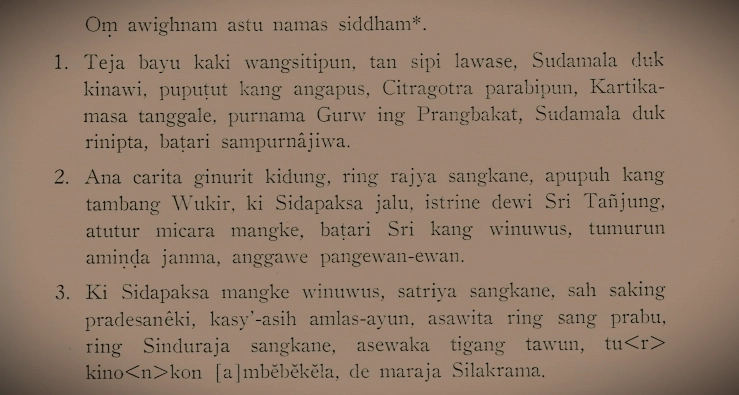
This indicates the number of syllables and the final vowel in the nine lines (a–i) that compose a stanza. For example, the first line (a) consists of 10 syllables and ends with the vowel “u.” The (i) in parentheses is an exceptional vowel. An example of the second stanza in the first chapter is as follows (the underlined part is the final vowel):
a. Ana carita ginurit kidung (this is a story in kidung)
b. ring rajya sangkan (it was composed in a palace)
c. apupuh kang tambang Wukir (sung in the Wukir style)
d. ki Sidapaksa jalu (the man’s name is Sidapaksa)
e. istrine dewi Sri Tañjung (his wife is a goddess Sri Tanjung)
f. atutur micara mangke (a story of miracle)
g. baṭari Sri kang winuwus (by the holy goddess)
h. tumurun amiṇḍa janma (who descended from heaven)
i. anggawe pangewan-ewan (in the shape of human)
The combination of syllables and final vowels forms a mechanism to sing the text in a specific melody. The metrical form is called pupuh, and there are many types of pupuh in Javanese and Balinese kidung. Therefore, the above pupuh Wukir is thought to have existed as one of the archaic oral techniques of kidung in Java and Bali. Prijono notes in his book that the pupuh Wukir form has the exact same structure as the pupuh Adri in Bali today.
4) Romanized transcription and story summary in prose
The most distinctive feature of Prijono’s work is the transformation of the lontar, originally a text for reciting poetry, into a book for “reading a story.” It thus generated a new relationship between texts, body, and thought, conforming to the structure of books brought about by European printing technology; in contrast, lontar is traditional handicraft media made by dried palm leaf, a small knife, and kemiri powder. With the start of Dutch colonialization, lontars were collected across the archipelagos and stored in Dutch libraries as important materials of regional histories. Afterward, the romanization and translation of these lontar were assigned to priyayis who received Dutch education, with Prijono’s work being one such example. In addition, Prijono served not only to transcribe and translate the patchworked manuscripts but also to summarize the “storyline” in Dutch prose (see section 5-2), meaning that the lontar of Sri Tanjung—an embodiment of poetry texture—was re-edited into another narrative structure of storytelling. In this way, with the development of printing technology in the early part of the last century, Prijono’s book on the Sri Tanjung story became a new medium of memory, as countless copies of the storyline can be found on the internet even today.